JINPAT LPT Hollow Shaft Slip Ring FAQ for Warehouse Robots
2026-09-29 16:58:59Q: Why does a warehouse robot need a hollow shaft slip ring?
A: If a robot’s platform, arm, vision module, or sorting mechanism rotates repeatedly, conventional cables can twist and wear. A hollow shaft slip ring transfers power and signals across the rotating interface without limiting rotation through cable movement.
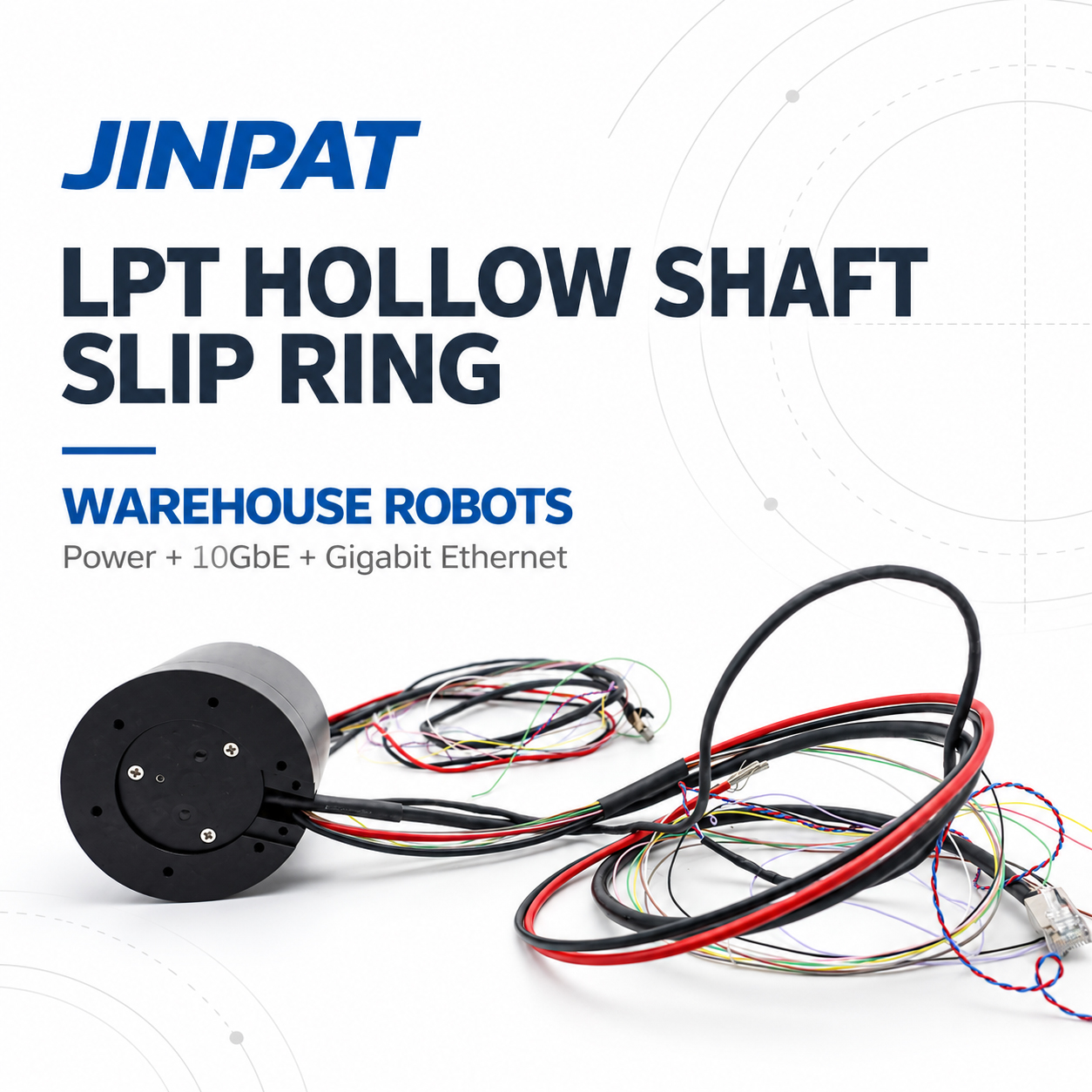
Q: What can a JINPAT LPT hollow shaft slip ring transmit?
A: The LPT series can be configured to transmit electrical power, 10 Gigabit Ethernet, and Gigabit Ethernet. This makes it suitable for power supply, robot control, industrial networking, machine vision, and high-speed data communication.
Q: When is 10 Gigabit Ethernet needed?
A: 10GbE is suitable for high-bandwidth requirements, such as high-resolution camera data, machine vision, image processing, and large-volume real-time data exchange.
Q: What is the benefit of the cap-style hollow shaft design?
A: The slip ring can be installed around a rotating shaft, while the central bore can accommodate a shaft, cables, or other components. This helps engineers create a more compact and flexible robot structure.
Q: What is the service life of the LPT slip ring?
A: JINPAT LPT hollow shaft slip rings are designed for up to 60 million revolutions. Actual service life may vary according to speed, load, operating environment, installation, and configuration.
Q: Can JINPAT customize the slip ring for our robot?
A: Yes. JINPAT can customize power circuits, 10GbE and Gigabit Ethernet channels, dimensions, bore size, connectors, speed, and installation requirements for warehouse robot applications.
Please share your drawing, circuit requirements, Ethernet configuration, installation space, and operating conditions. JINPAT can assist with slip ring selection and technical evaluation.