JINPAT LPT Hollow Shaft Slip Ring vs. Traditional Cables for Warehouse Robots
2026-09-29 16:29:46When designing a rotating warehouse robot, engineers often need to choose between a conventional cable arrangement and a rotary electrical connection solution. Both approaches may work in certain situations, but their suitability changes as rotation frequency, data volume, and system complexity increase.
Traditional cables can be practical for equipment with limited movement or a small rotation angle. However, when a robot needs continuous or repeated rotation, cables may become twisted, strained, or worn. As more power circuits, network lines, and sensor connections are added, cable routing can become increasingly difficult.
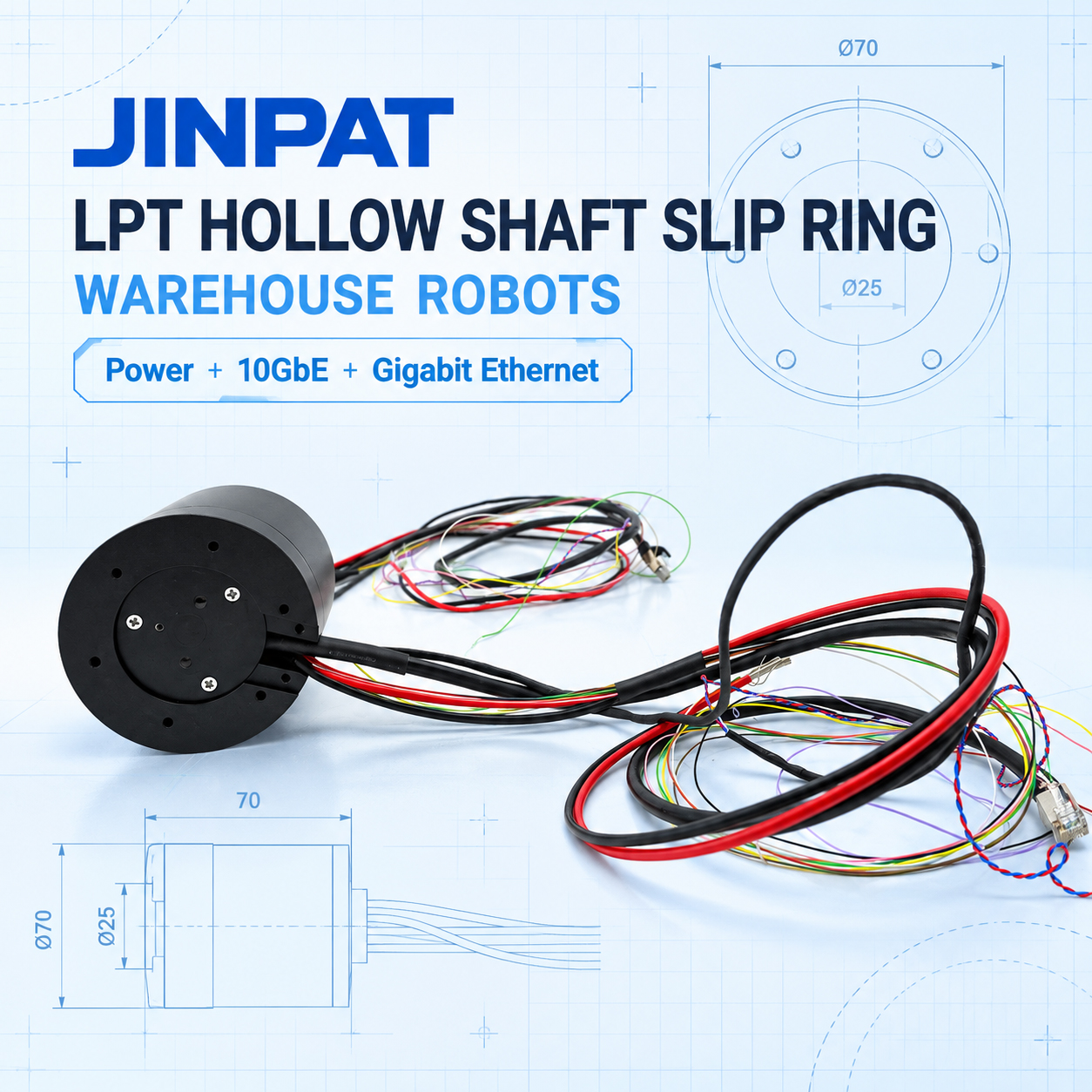
JINPAT LPT hollow shaft slip rings provide a more integrated solution for rotating systems. They can combine electrical power, 10 Gigabit Ethernet, and Gigabit Ethernet transmission in one rotary interface.
Compared with conventional cable routing, the LPT series offers several advantages:
- Supports continuous rotation without cable twisting
- Integrates power and high-speed Ethernet channels in one unit
- Helps simplify internal wiring and equipment layout
- Uses a cap-style hollow shaft structure for compact installation
- Offers up to 60 million revolutions of service life
- Can be customized for channels, bore size, dimensions, connectors, and operating conditions
For simple, low-rotation equipment, cables may still be sufficient. But for warehouse robots with continuous rotation, machine vision, and high-speed communication requirements, JINPAT LPT hollow shaft slip rings provide a more reliable long-term connection approach.